
Every week brings another prediction that artificial intelligence will finish off agencies. We wanted to see whether that story already shows up somewhere hard to argue with: Spain's commercial registry.
We analysed nearly 4.4 million filings published in the BORME, Spain's official commercial registry gazette, between January 2019 and October 2026, including about 845,000 company formations. The result isn't a collapse, but something quieter.
Key findings:
- Formation has stalled. Between January and October 2026, 1,466 agencies were formed, almost the same as in 2024 (1,461). Company formation overall grew 12.5% over that time.
- There's no wave of closures. Formal closures of companies with agency names remain below 2019 levels.
- Young agencies last less. Of those formed between 2021 and 2023, 5.7% closed before their third anniversary, compared with 3.8% of all companies.
- Mergers are almost invisible. Only 38 companies with agency names disappeared through absorption in nearly eight years.
Agency formation has been flat since 2024
Between 2019 and 2024, agency formation grew faster than the economy. Since then, it has stopped.
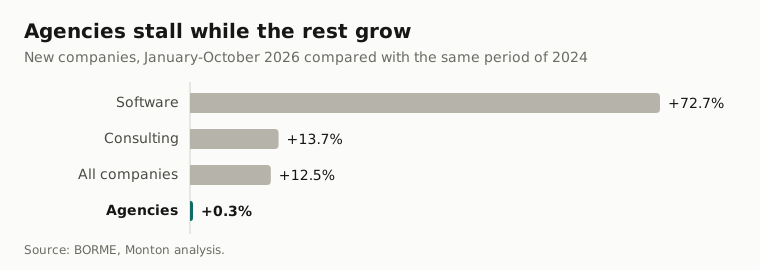
Agencies made up 1.47% of new companies in 2024. In 2026 they make up 1.31%, the lowest share since 2019. The plateau appears both among companies that declare an activity code and among those that describe their activity in free text, so it doesn't look like an effect of how filings are worded.
The contrast with software is striking: over the same period, new programming and IT consulting companies went from 1,568 to 2,708. We look at this in our analysis of software companies.
The full monthly series helps put those numbers in context:
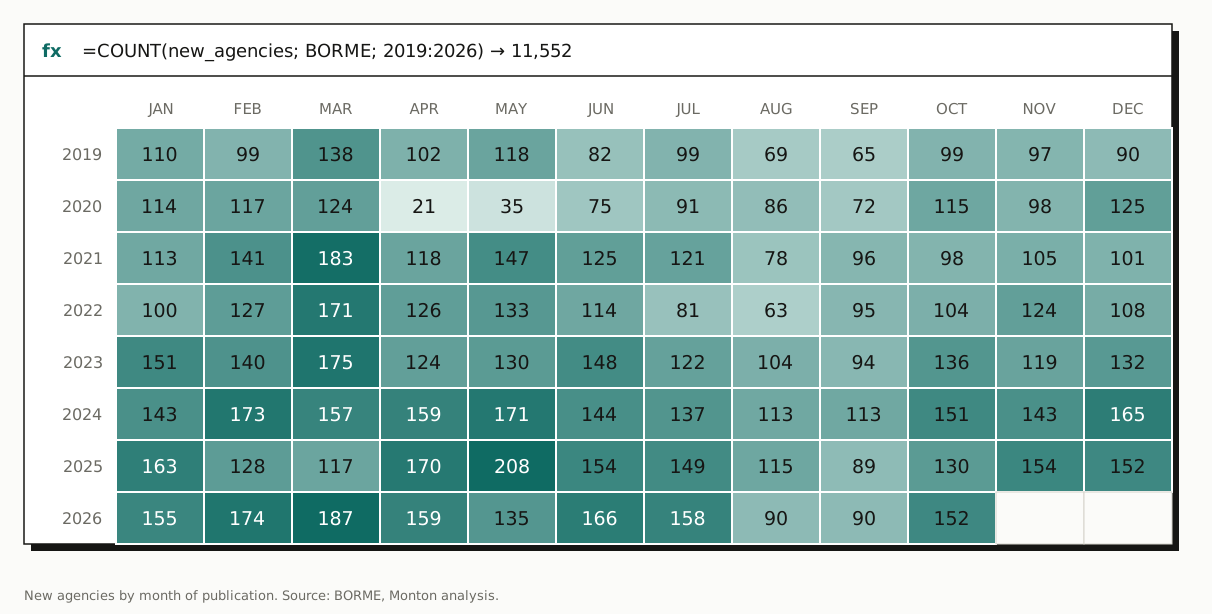
The lowest month is April 2020, in the middle of lockdown, with 21 agencies. The highest, May 2025, with 208, isn't specific to the sector: that month Spain's National Statistics Institute (INE) recorded 13,229 new companies, up 36.9% on a year earlier, and agencies held a normal share of 1.54%. The dip in August and September repeats almost every year.
Closures aren't surging
| January-October | New agencies | % of new companies | Formal closures* | Insolvencies* | Absorbed in mergers* |
|---|---|---|---|---|---|
| 2019 | 981 | 1.23% | 194 | 21 | 3 |
| 2020 | 850 | 1.32% | 152 | 19 | 0 |
| 2021 | 1,220 | 1.43% | 197 | 25 | 3 |
| 2022 | 1,114 | 1.35% | 181 | 25 | 4 |
| 2023 | 1,324 | 1.44% | 183 | 15 | 9 |
| 2024 | 1,461 | 1.47% | 169 | 11 | 3 |
| 2025 | 1,423 | 1.36% | 157 | 18 | 2 |
| 2026 | 1,466 | 1.31% | 167 | 23 | 6 |
* Sample of companies with agency names. It isn't the sector total and can't be compared directly with the new agencies column.
Formal closures in 2026 are 14% below 2019, while closures across all companies have risen 12%. Companies with agency names went from 0.77% to 0.59% of all closures.
Insolvencies have risen from 11 to 23 since 2024, but those numbers are too small to call a trend. Agencies account for 0.87% of insolvencies in 2026, almost the same as in 2019 (0.82%). The highest annual figure in the series was 2022, with 37 insolvencies, the year Spain's insolvency moratorium ended.
Young agencies don't last as long
The most worrying signal is in the first years of life. To measure it, we followed each company from its formation to any eventual closure.
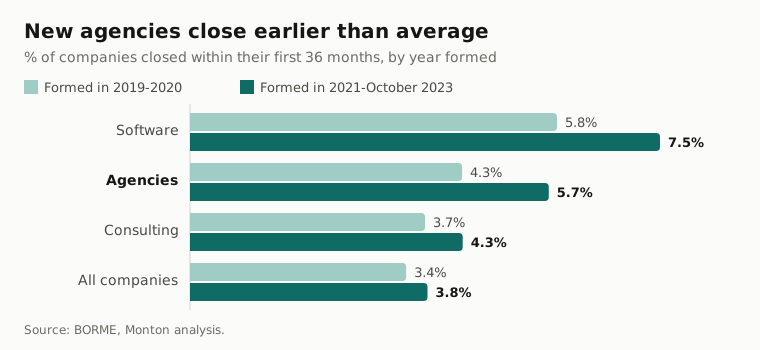
Agencies have always closed earlier than average, and the gap has widened. But this isn't only an agency problem. Software companies close even earlier, and they've got worse too. The pattern points to small digital and professional services businesses in general.
Almost nobody buys agencies through mergers
Between 2019 and October 2026, 20,592 companies in Spain disappeared through mergers. Only 38 had agency names. This doesn't mean there are no acquisitions in the sector, because many deals are share purchases that don't create a registered merger. What it does show is that most agencies don't disappear by being folded into another company.
AI barely appears in filings
Only 9 of the 1,466 agencies formed in 2026 mention artificial intelligence in their stated corporate purpose, or 0.6%, a share similar to that of all companies. It's a limited indicator, because the stated purpose tends to be generic and is often just an activity code. Even so, AI isn't yet being used as a mark of identity when an agency is formed.
The sector is spreading across the country
Madrid and Barcelona accounted for 52% of agencies formed in 2019. In 2025 that was 46%, a fall that isn't seen in the economy as a whole, where their share barely moved from 39% to 38%. Madrid explains most of the change, dropping from 31% to 26%.
What this data means, and what it doesn't
Official statistics up to 2024 describe a growing sector. According to Eurostat, advertising in Spain went from 49,851 to 57,194 companies between 2021 and 2024, and from €17,207 million to €21,938 million in turnover. The slowdown we see in the BORME begins just where that data ends, so there's no official figure yet to confirm or qualify it.
The registry shows what has changed, but not why. The plateau coincides with the adoption of generative AI, but other explanations are possible. One is that the 2023 and 2024 peak was inflated by Kit Digital, a Spanish government programme that funded digital services for small businesses. Another is that some people who once would have started an agency now register their company as software or consulting. This data can't separate those effects.
If you run an agency, the practical reading is less dramatic than the headlines: the visible risk isn't a sudden disappearance of the sector, but surviving the first few years. And that depends in large part on knowing the real margin of each client and project.
Methodology
Source. Registered filings (section one) of the BORME, published between 2 January 2019 and 30 October 2026. Dates are publication dates. We compare January-October of each year so that 2026 is included on equal terms. We didn't store directors' names and we don't name individual companies.
What counts as an agency. We count two groups, because closures and insolvencies don't state a company's activity:
- New agencies: companies whose stated main activity at formation is advertising, marketing, communications or public relations. This activity is declared, not verified. In a manual review of 100 random cases, 92 met the criterion.
- Name-based sample: companies with terms such as "publicidad", "marketing" or "comunicación" in their name, excluding telecoms, insurance and other false positives. In a review of 100 random closures, 91 appeared to be marketing or communications companies, judging by their names. Only 14% of agencies formed in 2025 would fall into this sample, so it works for seeing trends, not for calculating totals.
Survival. Includes only companies formed since 2019 with a complete observation period, linked by their registry sheet number. The software and consulting groups are defined by their stated activity and weren't reviewed manually.
Checks. Our 2025 count gives 128,231 companies formed, compared with 127,533 from the INE (+0.5%), and 26,863 dissolutions, compared with 26,073 (+3%).
Limitations.
- Formal closure doesn't capture every closure. Many companies stop operating without being formally closed, so real closure rates are higher.
- Sole traders don't appear in the BORME. Nor can we see staff or revenue cuts at agencies that remain open.
- Insolvencies are under-represented. Our series captures between half and two-thirds of the corporate insolvencies published by Spain's Association of Registrars, so we use it to compare shares.
- The law changed during the period. Law 18/2022 cut the minimum capital of a Spanish limited company to one euro, and the end of the insolvency moratorium affects 2022 insolvencies.
Data. Download the annual series and the monthly series as CSV (column headers are in Spanish). You're welcome to use them, citing Monton as the source.
Image. The main illustration was generated with artificial intelligence and doesn't represent data. The charts and tables come from the analysis described in this methodology.
Frequently asked questions
- Are more agencies closing in Spain?
- BORME data shows no wave of closures. Between January and October 2026, 167 companies with agency names were formally dissolved, compared with 194 in the same period of 2019. This is a sample, because the registry doesn't state the activity of companies that close.
- How many agencies are formed each year in Spain?
- In 2025, 1,729 companies were formed with advertising, marketing or communications agency work as their stated main activity. Between January and October 2026 there were 1,466, almost the same as in those months of 2024. The figure doesn't include sole traders.
- Is artificial intelligence causing agencies to close?
- This data can't show that. It shows what has changed in the registry, not why. The slowdown in new agencies coincides with the adoption of AI, but also with other factors, such as the course of the Kit Digital programme.
- Where does this data come from?
- From the registered company filings published in the Boletín Oficial del Registro Mercantil (BORME), Spain's official commercial registry gazette, between January 2019 and October 2026. Monton classified them using its own rules and publishes the aggregated data as a download.