
There's a lot of talk about artificial intelligence changing who can build software. We wanted to see what already shows up somewhere hard to argue with: Spain's commercial registry.
We analysed nearly 4.4 million filings published in the BORME, Spain's official commercial registry gazette, between January 2019 and October 2026, including about 845,000 company formations. The result is a clear boom, with two important caveats.
Key findings:
- Formation has more than tripled. Between January and October 2026, 2,708 software companies were formed, compared with 791 in 2019. Since 2024 alone they've grown 72.7%.
- AI appears rarely. Only 7.4% of 2026 software companies mention it in their name or stated corporate purpose.
- They close early. Of those formed between 2021 and October 2023, 7.5% were formally closed before their third anniversary, almost double the figure for all companies (3.8%).
- We don't yet know how it ends. The companies from the 2025 and 2026 boom are too young for their survival to be measured.
Software company formation is surging
Software companies made up 0.99% of new companies in 2019. In 2026 they make up 2.42%, and in October they reached 3.4%, with 367 companies, the monthly high of the series.
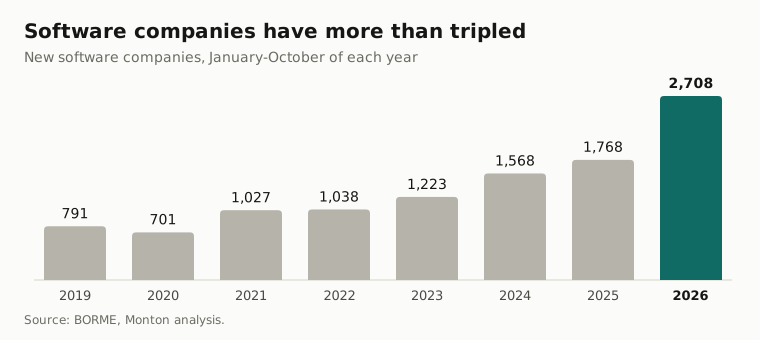
Most of the growth is programming, which went from 505 to 2,041 companies since 2019. IT consulting went from 286 to 667. In 2024, software overtook advertising, marketing and communications agencies in number of new companies, and the gap keeps growing.
The full monthly series shows when it speeds up:
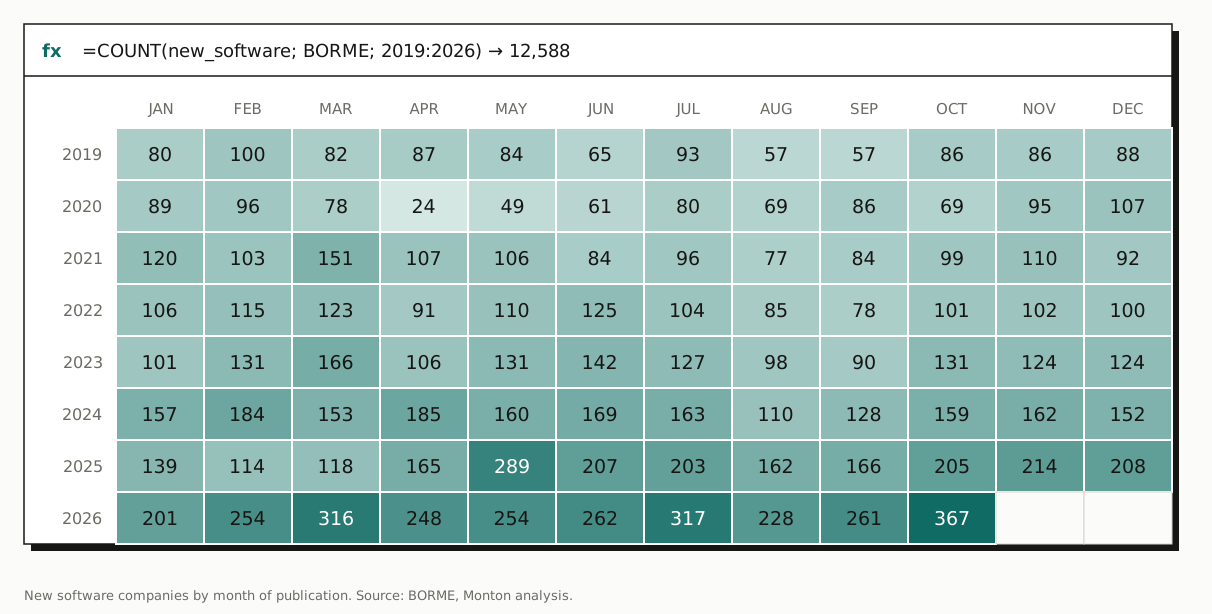
The lowest month is April 2020, in the middle of lockdown, with 24 companies. The jump comes from the second quarter of 2025, and in 2026 no full quarter falls below 760.
Is the boom real?
A jump like this calls for suspicion, especially because a new activity classification, CNAE-2025, took effect in January 2025 and changed the codes for programming and IT consulting. So we checked it against signals that don't depend on those codes, comparing 2024 and 2026:
- Company names. Companies in any activity with terms such as "tech", "labs", "software" or "data" in their name went from 1,496 to 2,743, up 83%.
- Mentions of software. Companies in any activity whose stated purpose talks about software or applications went from 1,460 to 2,504, up 72%.
- Changes of activity. Existing companies moving into software rose from 82 to 172.
All of them point the same way, far above the 12.5% growth of all companies. The boom looks real.
There is one caveat. Companies that describe their activity in their own words, without an official code or label, barely grew, from 167 to 184. The increase is concentrated in those using the official label, which says little about what they really do.
Closures aren't surging
| January-October | New companies | % of new companies | Formal closures* | Insolvencies* | Absorbed in mergers* |
|---|---|---|---|---|---|
| 2019 | 791 | 0.99% | 158 | 6 | 6 |
| 2020 | 701 | 1.09% | 110 | 10 | 6 |
| 2021 | 1,027 | 1.20% | 133 | 17 | 7 |
| 2022 | 1,038 | 1.26% | 174 | 9 | 14 |
| 2023 | 1,223 | 1.33% | 148 | 12 | 6 |
| 2024 | 1,568 | 1.58% | 146 | 11 | 7 |
| 2025 | 1,768 | 1.68% | 134 | 14 | 7 |
| 2026 | 2,708 | 2.42% | 171 | 10 | 15 |
* Sample of companies with software or IT names. It isn't the sector total and can't be compared directly with the new companies column.
Formal closures in 2026 are 8% above 2019, while closures across all companies have risen 12%. Companies in the sample stayed almost level, from 0.63% to 0.61% of all closures. Compared with 2025 they're up 28%, but still within the range of the series.
Insolvencies are few: between 6 and 17 in these periods. With numbers this small, we can't call it a trend.
This sample captures very few of the new companies, only 6% of those formed in 2025, so it says little about the boom. For that, we have to look at survival.
Software companies close earlier
We followed each company from its formation to any eventual closure.
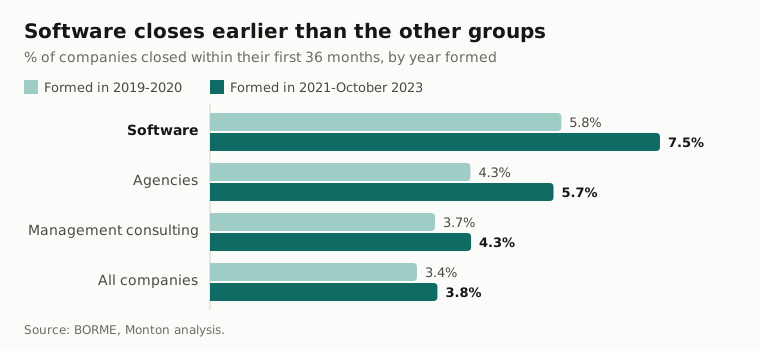
Software is the group that closes earliest of those we compared, and its rate has worsened. At five years the gap holds: 12.3% of those formed between 2019 and October 2021 closed within that period, compared with 6.8% of all companies.
These figures predate the boom. Companies formed in 2025 and 2026 haven't yet had time to close, so we don't know whether they'll last longer or shorter than earlier ones.
Mergers are scarce, but there are more of them
Between 2019 and October 2026, 20,592 companies in Spain disappeared through mergers, and 86 belonged to the software and IT sample. There have been 15 so far in 2026, the highest figure for those months since 2019, although almost the same as the 14 in 2022. Many acquisitions are share purchases that don't create a registered merger, so this figure doesn't capture all deal activity in the sector.
AI appears, but less than you'd expect
Of the 2,708 software companies formed in 2026, 201 mention AI in their name or stated corporate purpose, or 7.4%. In 2024 it was 4.1%, and in 2019, 0.8%. It's growing fast, but these 136 additional companies since 2024 are only 12% of the total increase.
AI isn't exclusive to software, either. Of the 655 companies in any sector that mention it in their stated purpose in 2026, only 84 are software companies.
This doesn't mean AI is irrelevant. A company can be created thanks to AI, or use it every day, without mentioning it in the registry. It only means that most new software companies don't present themselves as AI companies.
They start with less capital
Of 2026 software companies, 11.8% were formed with less than €3,000, compared with 5.5% of all companies. Before Law 18/2022 cut the minimum capital to one euro, it was less than 1%. Most are still formed with €3,000, but the use of low capital is more than double that of all companies.
The sector remains concentrated
Madrid and Barcelona accounted for 48% of software companies formed in 2025, almost the same as the 49% in 2019, and well above their share of the economy as a whole (38%). Between 2024 and 2026, among the larger provinces, Seville stands out, from 38 to 82 companies, and Valencia, from 122 to 209.
What this data means, and what it doesn't
Official statistics up to 2024 describe a large, growing sector. According to Eurostat, programming and IT consulting in Spain went from 39,421 to 46,951 companies between 2021 and 2024, from 343,812 to 460,833 people employed and from €36,038 million to €56,954 million in turnover. The biggest jump we see in the BORME begins just where that data ends, so there's no official figure yet to confirm or qualify it.
The registry shows what has changed, but not why. One possible explanation is that AI tools have made building software cheaper, even if companies don't mention it. Others are Spain's Startups Act, the one-euro minimum capital, or more independent professionals now invoicing through a company. This data can't separate those effects.
If you're starting a software company, the practical reading is that more new companies are entering than ever before, and that the first three years are still the hard part. Forming the company keeps getting easier. Keeping it open, less so.
Methodology
Source. Registered filings (section one) of the BORME, published between 2 January 2019 and 30 October 2026. Dates are publication dates. We compare January-October of each year so that 2026 is included on equal terms. We didn't store directors' names and we don't name individual companies.
What counts as a software company. We count two groups, because closures and insolvencies don't state a company's activity:
- New companies: companies whose stated main activity at formation is programming, software development or IT consulting. This activity is declared, not verified: some have names that don't look like they belong to this sector. In a manual review of 100 random cases, 98 met the criterion, and in another of 60 cases from 2026, all 60 did.
- Name-based sample: companies with terms such as "software", "informática" or "apps" in their name, excluding economic interest groupings and other false positives. In a review of 100 random closures, 96 appeared to be IT companies, judging by their names, although some sold equipment rather than software. Only 6% of software companies formed in 2025 would fall into this sample, so it works for seeing trends, not for calculating totals.
Artificial intelligence. We count companies that mention AI in their name or stated corporate purpose. In a review of 60 random cases from 2026, all 60 were correct. This is a minimum, because the stated purpose is published in summarised form.
Survival. Includes only companies formed since 2019 with a complete observation period, linked by their registry sheet number. The agency and management consulting groups are defined by their stated activity. The management consulting group wasn't reviewed manually.
Checks. Our 2025 count gives 128,231 companies formed, compared with 127,533 from Spain's National Statistics Institute (INE) (+0.5%), and 26,863 dissolutions, compared with 26,073 (+3%).
Limitations.
- Formal closure doesn't capture every closure. Many companies stop operating without being formally closed, so real closure rates are higher.
- Sole traders don't appear in the BORME. Nor can we see staff or revenue cuts at companies that remain open.
- A new company isn't a software product. The official label covers people who build products as well as those who sell services or work as independent professionals.
- The code change affects 2025. With CNAE-2025, programming moved from code 62.01 to 62.10. The first quarter of 2025 shows a drop (371 companies) followed by a rebound (661), which may partly reflect that transition.
- Insolvencies are under-represented. Our series captures between half and two-thirds of the corporate insolvencies published by Spain's Association of Registrars, so we don't use it as a total.
Data. Download the annual series and the monthly series as CSV (column headers are in Spanish). You're welcome to use them, citing Monton as the source.
Image. The main illustration was generated with artificial intelligence and doesn't represent data. The charts and tables come from the analysis described in this methodology.
Frequently asked questions
- How many software companies are formed in Spain?
- Between January and October 2026, 2,708 companies were formed with programming or IT consulting as their stated main activity, compared with 1,568 in those months of 2024 and 791 in 2019. The figure doesn't include sole traders.
- Is the software company boom caused by artificial intelligence?
- This data can't show that. Only 7.4% of software companies formed in 2026 mention AI in their name or stated corporate purpose. That doesn't rule out AI having an influence in other ways, such as making development cheaper, but the registry doesn't show it.
- How many software companies close early?
- Of those formed between 2021 and October 2023, 7.5% were formally closed within their first 36 months, compared with 3.8% of all companies. This is a minimum, because many companies stop operating without being formally closed.
- Where does this data come from?
- From the registered company filings published in the Boletín Oficial del Registro Mercantil (BORME), Spain's official commercial registry gazette, between January 2019 and October 2026. Monton classified them using its own rules and publishes the aggregated data as downloads.