
After analysing how many agencies open and close in Spain, we were left with an open question. The commercial registry only sees companies, so it says nothing about jobs or the self-employed.
To answer it, we combined Eurostat's sector accounts with the business directory and labour cost survey from INE, Spain's statistics office. The result is a sector that bills more but barely hires.
Key findings:
- More turnover, the same number of employees. From 2019 to 2024, advertising and market research turnover grew 20.1%, slightly above inflation (18.3%). Employees went from 88,747 to 89,485, just 738 more.
- The growth is among the self-employed. In advertising they rose from 23,041 to 31,696 between 2020 and 2025, up 37.6%. Across the whole economy they fell 2.1%.
- A few companies carry a lot of weight. The 41 companies with 250 or more people generate 45.2% of turnover.
- Software is on a different path. It added 150,727 employees over the same period, even though its prices have risen far less than inflation.
The sector bills more, but barely hires
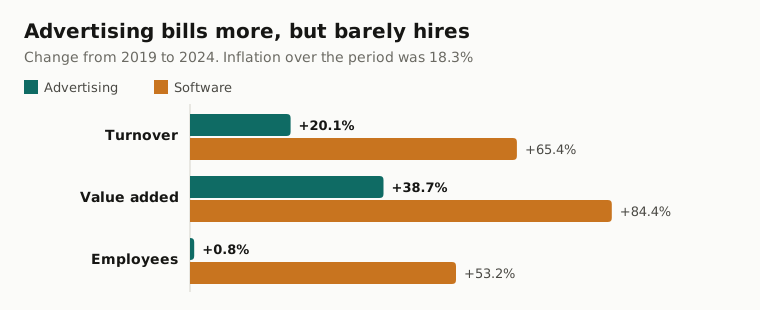
After inflation, advertising turnover has grown just 1.5% in five years. Value added, which is what remains after paying other companies for purchases, has risen much more. The sector now keeps 29.5% of what it bills, compared with 25.6% in 2019.
| Indicator | Advertising 2019 | Advertising 2024 | Change | Software 2019 | Software 2024 | Change |
|---|---|---|---|---|---|---|
| Turnover (€ million) | 19,191 | 23,054 | +20.1% | 34,438 | 56,954 | +65.4% |
| Value added (€ million) | 4,911 | 6,811 | +38.7% | 16,917 | 31,190 | +84.4% |
| Employees | 88,747 | 89,485 | +0.8% | 283,333 | 434,060 | +53.2% |
| People employed | 122,917 | 127,449 | +3.7% | 310,036 | 460,833 | +48.6% |
The contrast with software is large. Counting employees and non-employees, advertising employs 4,532 more people than in 2019, and software 150,797 more.
The growth is among the self-employed
INE's business directory separates individuals from companies. In advertising, the self-employed increased by 8,655 between 2020 and 2025. That's more than the activity's total increase of 7,603 businesses, because limited companies fell from 17,425 to 16,854. The self-employed went from 53.6% to 62.7% of businesses.
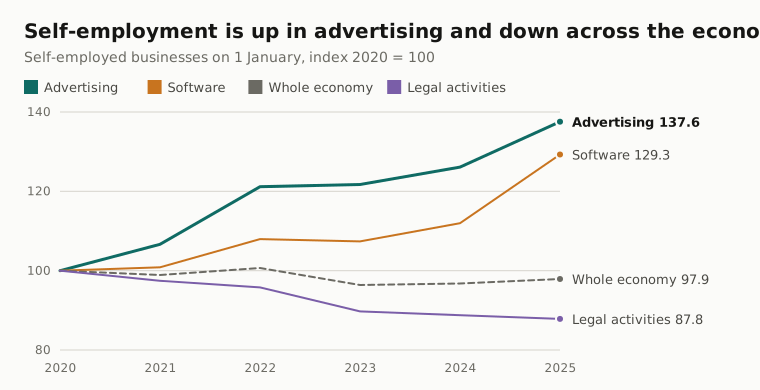
This isn't a general trend in professional services. In accounting, law and architecture, self-employment fell by more than 10%.
| Activity | 2020 | 2025 | Change |
|---|---|---|---|
| Advertising | 23,041 | 31,696 | +37.6% |
| Management consulting | 4,551 | 5,895 | +29.5% |
| Software and IT | 16,094 | 20,807 | +29.3% |
| Whole economy | 1,899,810 | 1,859,925 | −2.1% |
| Accounting and tax advice | 32,401 | 28,820 | −11.1% |
| Legal activities | 76,917 | 67,557 | −12.2% |
| Architecture and engineering | 65,348 | 56,716 | −13.2% |
Among the 54 activities with at least 5,000 self-employed people in 2020, advertising had the third-fastest growth. Only other postal and courier activities, which include delivery work, and sports activities grew faster.
This fills in what we saw in the BORME, Spain's commercial registry gazette: the formation of agencies set up as companies has stalled since 2024. Part of the activity seems to be growing outside that registry.
A sector split in two
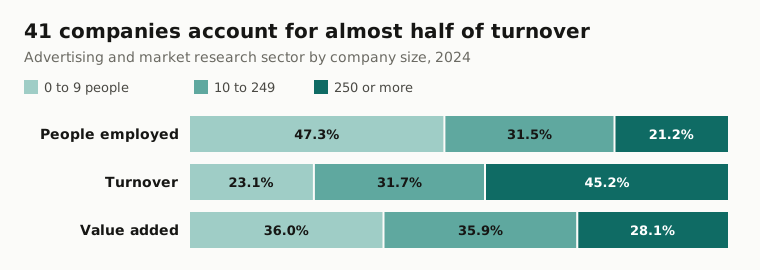
The 41 companies with 250 or more people employ 21.2% of the sector and generate 45.2% of turnover, but only 28.1% of value added. That gap fits a business that bills heavily on behalf of others, such as media buying, although this data doesn't break it down.
At the other end, companies with up to nine people account for almost half of jobs and 23.1% of turnover. Each person generates €40,700 of value added a year, compared with €70,800 at the largest companies.
Labour costs more, and prices don't always follow
| Change from 2019 to 2025 | Advertising | Software |
|---|---|---|
| Price of services | Not available | +8.8% |
| Labour cost per worker | +45.8% | +31.1% |
| Inflation | +21.5% | +21.5% |
Labour cost per worker has grown faster than inflation in both sectors. In advertising, INE's survey shows a rise of 45.8% from 2019 to 2025, from €2,919 to €4,255 a month. This figure needs caution: up to 2024, the survey shows 38.3%, while Eurostat's accounts show 27.0%. In software, the two sources almost match (23.7% and 22.8%).
The most solid price data is for software. Prices for programming and IT consulting rose 8.8% from 2019 to 2025, against inflation of 21.5%. That's similar to Germany (8.5%) and France (8.3%), and below Italy (13.9%) and the EU (15.4%).
There's no equivalent figure for agencies. INE publishes an advertising price index, but it's built on data from InfoAdex and swings widely by quarter, from 95 to 118 in 2019. We don't read it as a measure of what agencies charge for their work, so we don't use it here.
What this data means, and what it doesn't
The data shows that the sector has grown without adding employees and that self-employment has risen sharply. It doesn't show why.
There are several possible explanations. Agencies may be hiring freelancers instead of expanding their teams. Former employees may have set up on their own. Digital tools and AI may let one person provide services that used to need a team. Grants from the Kit Digital programme may also have played a part. This data can't separate those effects.
Nor does it show whether agencies earn more. The sector's gross operating surplus rose 60%, from €1,622 million to €2,598 million, but that figure includes what the self-employed earn themselves, which isn't recorded as a personnel cost. With more and more self-employed people, it rises even if no business improves. Eurostat's data for these sectors also lacks personnel costs by company size, which would isolate agencies with staff.
If you run an agency, the practical reading is that the market has more and more independent professionals, whether as competitors or collaborators. With labour costs rising faster than inflation, knowing what each project really costs matters more than it did five years ago.
Methodology
Sources. For the sector, Eurostat: business statistics up to 2020, from 2021 and by size. For the self-employed, INE's Central Business Directory. For costs, the Quarterly Labour Cost Survey. For prices, the Services Producer Price Index and Eurostat's European data. Inflation is Spain's HICP, as annual averages.
What each sector includes. "Advertising" is division 73 of Spain's CNAE-2009 classification in the Eurostat and labour cost data, so it includes market research. In the self-employment data, it's group 731 only, advertising. "Software" is division 62: programming, consultancy and other IT activities. Businesses declare their own activity.
Periods. Eurostat's accounts run to 2024. INE's directory refers to 1 January of each year, so 2020 and 2025 roughly match the end of 2019 and 2024. Costs and prices are annual averages up to 2025.
Checks. We don't use Eurostat's number of companies, which jumps 18% in 2021 alone, when the statistics change, and goes from below INE's directory to 13% above it. The turnover, employment and value added figures show no such jump.
Limitations.
- Eurostat's series changes in 2021. We compare 2019 and 2024 across two datasets with different rules. From 2021 to 2024 alone, turnover grew 26.0% and employees 10.6%, but 2021 was still affected by the pandemic.
- INE's directory has a break in 2023. That year, businesses fall across the whole economy, and limited companies in advertising drop from 17,688 to 15,588, so comparing them with 2020 is unreliable. From 2023 to 2025 alone, self-employment in advertising grew 13.0%, against 1.6% across the economy, and limited companies grew 8.1%.
- A registered self-employed person isn't a full-time job. Eurostat shows only about 3,800 more non-employees at work from 2019 to 2024, fewer than the directory's rise in self-employment. Some may have another occupation or limited activity.
- We haven't checked employment against Social Security registrations.
- The data ends in 2024 and 2025. It says nothing about what's happening in 2026.
Data. Download the data as CSV (with Spanish headers). You can use it if you credit Monton as the source.
Image. The main illustration was generated with artificial intelligence and doesn't represent data. The charts and tables come from the analysis described in this methodology.
Frequently asked questions
- How many people work in advertising in Spain?
- According to Eurostat, the advertising and market research sector employed 127,449 people in 2024, of whom 89,485 were employees. In 2019 the figures were 122,917 and 88,747.
- How many self-employed people work in advertising in Spain?
- The business directory of INE, Spain's statistics office, listed 31,696 self-employed people in advertising on 1 January 2025, compared with 23,041 in 2020. They make up 62.7% of businesses in the activity.
- Have advertising agency prices gone up?
- No official figure measures this. INE's advertising price index is built on data from InfoAdex, and we don't read it as a measure of what agencies charge for their work.
- Do agencies earn more than in 2019?
- This data can't show that. The sector's surplus has risen, but it includes the income of self-employed people, whose numbers are growing. That makes it a poor measure of agency margins.